
After Nebuchadnezzar II’s death, the Neo-Babylonian Empire faced internal instability and external threats. The Judean exile to Babylon profoundly influenced Jewish thought and religious development. Meanwhile, Chaldean astronomers made groundbreaking discoveries that would influence Greek and Roman science for centuries. Their precise astronomical observations and mathematical calculations became the foundation for later scientific advancement.
ENTRY 13: JUDEAN EXILES IN BABYLON
Time Period: 597-539 BCE

Following Nebuchadnezzar II’s conquest of Jerusalem in 597 and 586 BCE, thousands of Judeans were exiled to Babylon. This period, known as the Babylonian Captivity or Exile, lasted approximately 70 years and profoundly shaped Jewish identity, theology, and religious practice.
The exiles settled in Babylonian cities, where they encountered Chaldean culture, Aramaic language, and Mesopotamian intellectual traditions. Many Judean exiles adopted Aramaic as their primary language, which remained the language of Jewish communities for centuries.
Historical Impact:
- Development of synagogue worship
- Compilation of Hebrew scriptures
- Adoption of Aramaic language
- Cultural exchange between Judean and Chaldean communities
ENTRY 14: INFLUENCE ON JEWISH TALMUD AND KABBALAH
Time Period: 6th Century BCE – Medieval Period

The Babylonian Talmud, compiled between the 3rd and 5th centuries CE, reflects centuries of Jewish scholarship in Mesopotamia. The text’s language (Babylonian Aramaic), legal concepts, and astronomical knowledge show significant Chaldean influence.
Kabbalistic traditions also absorbed Mesopotamian cosmological concepts and mystical practices that originated in Chaldean religious thought. The synthesis of Jewish and Chaldean wisdom created a rich intellectual heritage.
Cultural Exchange:
- Aramaic as language of Talmud
- Astronomical calculations in Jewish calendar
- Mystical traditions influenced by Chaldean practices
ENTRY 15: FALL OF THE CHALDEAN EMPIRE
Time Period: 539 BCE

In 539 BCE, the Persian king Cyrus the Great conquered Babylon, ending Chaldean rule and incorporating Mesopotamia into the vast Achaemenid Persian Empire. The last Chaldean king, Nabonidus, fled the city without a fight.
Despite the political end of the Chaldean Empire, Chaldean culture, language, scholarship, and influence continued. Babylon remained a center of learning, and Chaldean astronomers and scholars served Persian kings.
End of Empire:
- Cyrus the Great’s conquest (539 BCE)
- Release of Judean exiles
- Continuation of Chaldean scholarship under Persian rule
ENTRY 16: BABYLONIAN ASTRONOMICAL DIARIES
Time Period: 7th Century BCE – 1st Century BCE

The Babylonian Astronomical Diaries are a collection of cuneiform tablets recording daily astronomical observations, weather conditions, market prices, and significant events. These records span over 700 years and represent one of humanity’s longest continuous scientific projects.
Chaldean astronomers meticulously documented celestial phenomena, creating the foundation for predictive astronomy. Their observations of lunar and planetary cycles achieved remarkable precision without telescopes.
Scientific Achievement:
- 700+ years of continuous astronomical records
- Precise calculations of lunar and planetary cycles
- Foundation for Greek and Roman astronomy
ENTRY 17: GREEK CHRONICLES RECORDING CHALDEAN ASTRONOMY
Time Period: 4th – 1st Century BCE

Greek historians and astronomers, including Aristotle, Ptolemy, and Hipparchus, acknowledged their debt to Chaldean astronomical knowledge. They studied Babylonian records and incorporated Chaldean calculations into Greek scientific thought.
This transmission of knowledge from East to West became a crucial link in the development of Western science.
Greek Recognition:
- Aristotle’s references to Chaldean observations
- Ptolemy’s use of Babylonian data
- Hipparchus’ reliance on Chaldean eclipse records
ENTRY 18: NABURIMANNU, THE CHALDEAN ASTRONOMER
Time Period: ~6th Century BCE
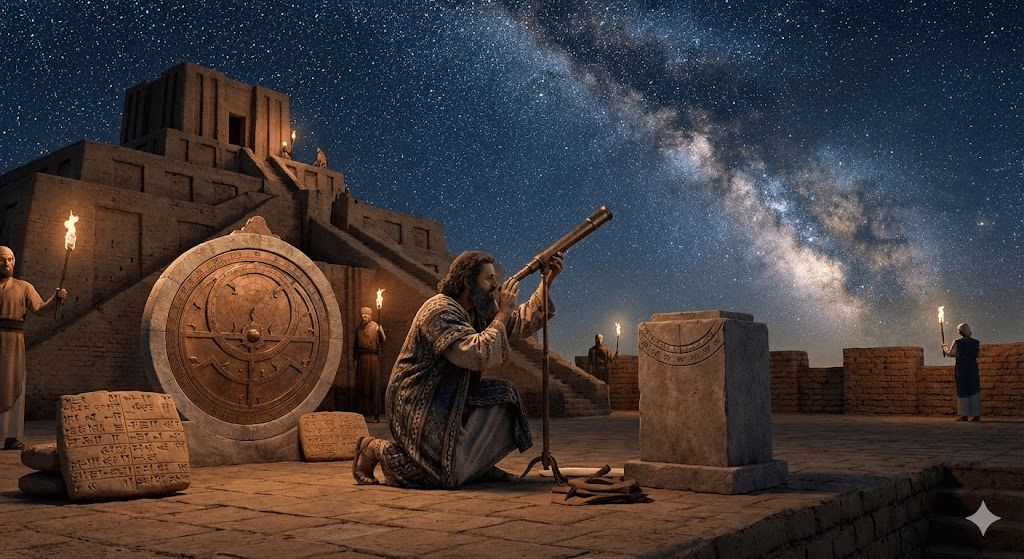
Naburimannu (also spelled Naburimanu) was a renowned Chaldean astronomer whose work influenced generations of scholars. He developed sophisticated mathematical methods for predicting lunar and planetary positions.
His calculations achieved accuracy that wouldn’t be surpassed for over a millennium. Greek astronomer Hipparchus later used Naburimannu’s observations in his own groundbreaking work.
Contributions:
- Lunar cycle calculations
- Planetary motion predictions
- Influence on Greek astronomy
ENTRY 19: KIDINNU, MASTER ASTRONOMER
Time Period: ~4th Century BCE

Kidinnu (Greek: Cidenas) was a Chaldean astronomer and mathematician whose work represented the pinnacle of Babylonian astronomical science. He developed the most accurate ancient calculation of the lunar month and created tables for predicting eclipses.
His value for the length of the lunar month differed from the true value by only 0.6 seconds. This extraordinary precision wasn’t achieved again until modern times.
Scientific Legacy:
- Most accurate ancient calculation of lunar month
- Eclipse prediction tables
- Influence on Hellenistic astronomy
ENTRY 20: SUDINES, ASTRONOMER TO THE GREEKS
Time Period: ~3rd Century BCE

Sudines was a Chaldean astronomer who brought Babylonian astronomical knowledge directly to the Greek world. He lived and taught in Greece, translating Chaldean astronomical concepts for Hellenistic audiences.
Greek and Roman authors frequently cited Sudines as an authority on celestial phenomena, particularly comets and planetary movements.
Cultural Bridge:
- Direct transmission of Chaldean knowledge to Greeks
- Authority on comets and planets
- Integration of Eastern and Western astronomy
ENTRY 21: SELEUCUS OF SELEUCIA, THE CHALDEAN ASTRONOMER
Time Period: ~2nd Century BCE

Seleucus of Seleucia was a Chaldean astronomer who made a remarkable contribution to ancient science: he supported and developed the heliocentric theory proposed by Aristarchus of Samos.
Eighteen centuries before Copernicus, Seleucus argued that the Earth and other planets revolve around the Sun. He also correctly explained tidal movements as being caused by the Moon’s gravitational pull.
Revolutionary Ideas:
- Support for heliocentric theory
- Explanation of tides through lunar influence
- Challenge to geocentric worldview
ENTRY 22: INFLUENCE ON GREEK AND ROMAN SCIENCES
Time Period: 4th Century BCE – 2nd Century CE

Chaldean astronomical knowledge profoundly influenced Greek and Roman science. Ptolemy’s Almagest, the most influential astronomical work of antiquity, relied heavily on Babylonian observations spanning centuries.
Greek astronomers Hipparchus, Eudoxus, and later Roman scholars openly acknowledged their debt to Chaldean predecessors. The zodiac, astronomical units of measurement, and sophisticated mathematical techniques all originated in Mesopotamia.
Lasting Impact:
- Foundation of Western astronomy
- Development of zodiac system
- Mathematical methods for celestial calculations
ENTRY 23: CHURCH OF THE EAST
Time Period: 1st – 7th Century CE

The Church of the East, also known as the Nestorian Church, became the dominant Christian denomination among Chaldeans and other Aramaic-speaking peoples of Mesopotamia. This church traced its origins to the apostolic era and claimed foundation by the Apostle Thomas.
By the 7th century, the Church of the East had spread across Asia, establishing missions from Persia to China. Chaldean Christians played a crucial role in preserving and transmitting classical knowledge during the medieval period.
Christian Heritage:
- Apostolic origins in Mesopotamia
- Aramaic liturgy and scriptures
- Spread across Asia
- Preservation of classical knowledge
ENTRY 24: JULIAN THE CHALDEAN
Time Period: 2nd Century CE

Julian the Chaldean (also called Julian the Theurgist) was a philosopher and author of the Chaldean Oracles, a collection of mystical texts that influenced Neoplatonic philosophy and late Roman religious thought.
These oracles combined elements of Babylonian religious tradition with Greek philosophy, creating a syncretic system that attracted intellectuals throughout the Roman Empire.
Philosophical Influence:
- Synthesis of Eastern and Western mysticism
- Author of Chaldean Oracles
- Influence on Neoplatonism
 EXPLORE THE CHALDEAN HISTORY